Education sector update
Back to School: A Practical Risk and Compliance Update
The start of the academic year is a natural assurance point. Buildings, equipment and procedures may have changed during the summer, while new pupils, employees and contractors bring different needs and levels of familiarity.
This update focuses on two priorities for September 2026: the strengthened allergy-safety arrangements expected in schools and a practical premises reset before normal occupancy resumes.

Priority 01 | Allergy safety
Benedict’s Law: What Schools Need to Have in Place for September 2026
New Department for Education guidance places allergy safety firmly within school leadership, policy, training and risk-management arrangements. The response must be a working system, not a document produced for the website.
Why expectations are changing
Benedict’s Law was created following the death of five-year-old Benedict Blythe after an allergic reaction at school. The campaign has helped drive a more consistent national approach to allergy safety in education.
The Department for Education published statutory allergy-safety guidance for schools in England in July 2026. It takes effect from September and applies to governing bodies of maintained schools and pupil referral units and to academy proprietors within scope. The government has also indicated how comparable expectations will be taken forward for independent schools.
The guidance expects schools to treat allergy safety as an organisational responsibility. Key elements include a published policy, clear leadership, all-staff training, individual healthcare plans, access to prescribed and spare adrenaline auto-injectors where applicable, and learning from serious incidents and near misses.
Leadership and governance
Each school should identify a senior leadership team member with responsibility for the allergy policy. Governing bodies and proprietors should be able to see that arrangements have been implemented, resourced and reviewed, not simply delegated to catering or first-aid staff.
The school’s policy should be published, reviewed at least annually and updated when needs or circumstances change. Allergy risks should also be reflected in wider risk-management arrangements, including the school risk register where appropriate.
Useful governance questions include:
- Who is the accountable senior leader and who coordinates the arrangements day to day?
- How does the governing body receive assurance?
- Does the policy reflect the school’s actual pupils, premises, catering and activities?
- Are responsibilities clear during breakfast clubs, after-school provision, trips and lettings?
- What happens when a pupil’s diagnosis, medication or care plan changes?
Individual healthcare plans
Pupils with known allergies should have an individual healthcare plan developed with parents or carers and relevant healthcare professionals. The plan should be readily accessible to the people who need it while being handled in line with data-protection requirements.
The plan should give staff practical information, including:
- the pupil’s allergens and typical symptoms;
- steps to prevent exposure;
- prescribed medication and where it is kept;
- how to recognise and respond to an emergency;
- who should be contacted;
- arrangements for meals, practical lessons, trips and other activities; and
- any reasonable adjustments needed for inclusion and wellbeing.
A plan is only effective if the people supervising the pupil understand it. Schools should test accessibility during realistic conditions, including temporary cover, lunchtime, clubs and off-site visits.
Training for all staff
All employees need a level of allergy awareness appropriate to their role. This includes teachers, support employees, leaders, catering teams, lunchtime supervisors, site staff and others who may encounter a pupil or respond to an emergency.
Training should cover:
- common allergens and routes of exposure;
- prevention and cross-contact;
- how to recognise an allergic reaction and anaphylaxis;
- the school’s emergency procedure;
- the location and use of adrenaline auto-injectors;
- individual responsibilities and escalation; and
- inclusion, communication and the emotional impact of living with allergy.
Role-specific instruction will still be needed for employees responsible for medication, food service, curriculum activities or trips. Training should be refreshed and supported by drills or scenario-based checks so leaders know that knowledge can be applied under pressure.
Adrenaline auto-injectors and emergency readiness
Schools should have reliable arrangements for pupils’ prescribed adrenaline auto-injectors and any spare devices held in accordance with the applicable rules. Storage must balance rapid access, security and the manufacturer’s requirements.
Checks should cover:
- device location and accessibility throughout the school day;
- expiry dates and replacement arrangements;
- the connection between the pupil, medication and individual plan;
- availability during trips, sport and off-site activity;
- responsibility when a pupil moves between areas; and
- prompt contact with emergency services and parents or carers.
Emergency arrangements should not depend on one named person being present. Schools should consider what happens during absence, breaks, cover lessons and extended provision.
Food, curriculum and the wider school day
Allergen management extends beyond the main kitchen. Breakfast clubs, packed lunches, vending, celebrations, fundraising, cookery lessons, science activities, art materials, school pets and external hirers can all introduce exposure.
The control approach should avoid blanket rules that cannot be enforced or that create a false sense of security. It should be based on the needs of individual pupils, reliable information, sensible prevention, supervision and emergency preparedness.
Schools should work with catering providers and other contractors to confirm responsibilities, ingredient and menu information, cross-contact controls, substitutions and incident reporting. Changes should be communicated before they reach the point of service.
Record, review and learn
Serious incidents and near misses should be recorded and reviewed. Learning should look beyond the final human error to the conditions that made it possible: incomplete information, unclear ownership, rushed handovers, inaccessible medication, inconsistent supervision or an activity not considered in the plan.
The findings should update policies, individual plans, training and wider risk assessments where relevant.
September readiness checklist
PHSC can support schools and academy trusts with policy review, allergy risk assessment, training, emergency exercises and independent assurance.
Discuss allergy-safety support for your school or trustTechnical source note
Department for Education, Allergy safety in schools, published 6 July 2026: https://www.gov.uk/government/publications/allergy-safety-in-schools
The Benedict Blythe Foundation, Benedict’s Law:
Benedict’s Law
Priority 02 | Premises assurance
Reopening Safely: A Premises Risk Reset Before Pupils Return
Summer works, reduced occupancy and changes in personnel can alter the school risk picture. A focused pre-opening review helps identify the conditions that paperwork alone may miss.
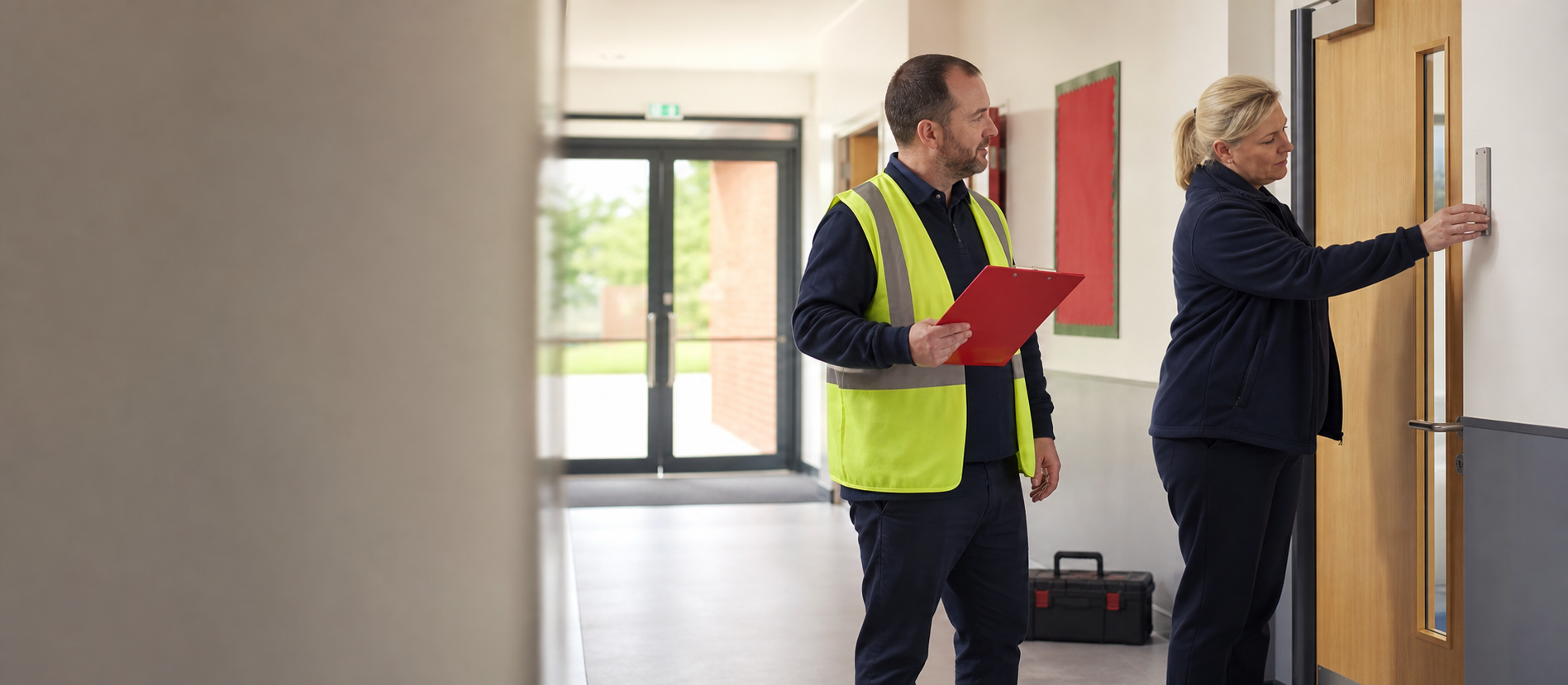
Reoccupation is a change, not merely a date
Many schools remain operational in some form throughout the summer, but the conditions are different. Occupancy falls, water systems are used less, rooms are repurposed, contractors complete projects and equipment is moved. When normal activity resumes, thousands of small interactions return at once.
The objective of a pre-opening review is not to repeat every annual assessment. It is to confirm that safety-critical controls are available, summer changes have been captured and the building is ready for its intended use.
Close out summer works properly
A finished-looking project may still have outstanding safety information, temporary controls or incomplete commissioning.
For each project, confirm:
- the work has been formally handed back and the area is safe to occupy;
- fire stopping, alarms, emergency lighting and escape routes have not been compromised;
- asbestos information and the management plan have been updated where relevant;
- new equipment has been commissioned and instructions provided;
- residual defects and temporary arrangements have owners and deadlines;
- construction materials, tools and waste have been removed; and
- changes are reflected in drawings, registers, risk assessments and emergency plans.
Do not allow timetable pressure to convert an incomplete handover into informal acceptance.
Check water hygiene after reduced use
Low use and stagnation can increase water-hygiene risk. The responsible person should confirm that the water-safety plan has been followed, including flushing, temperature checks, outlet management, cleaning or disinfection and any sampling specified by the assessment or water-hygiene specialist.
Pay attention to little-used outlets, showers, changing facilities, drinking-water points, science areas, external blocks and facilities isolated during works. Record actions and investigate results outside expected parameters.
Keep asbestos information usable
Schools with buildings constructed before 2000 may contain asbestos. The management survey, register and plan must be available and accurate, but the practical question is whether the people who could disturb the building know how to use them.
Before term starts:
- update records for summer works and any newly identified materials;
- inspect known or presumed asbestos-containing materials as required by the plan;
- brief new site staff and relevant employees;
- make sure contractors sign in and receive the correct information before work begins; and
- reinforce the stop-work process for unexpected materials or damage.
Pinning an asbestos register to a shared drive is not the same as controlling intrusive work.
Walk every escape route
Complete a physical check of escape routes, final exits, fire doors, alarm call points, signage, emergency lighting and assembly arrangements. Confirm that layout or occupancy changes have been considered in the fire risk assessment.
Personal emergency evacuation plans and other assistance arrangements should reflect new pupils and employees. Those responsible for roll calls, evacuation support or opening gates should understand their roles, including during extended-day activities and lettings.
Reconcile work equipment and statutory checks
Check that equipment added, moved or returned after repair is on the relevant maintenance and inspection system. Review due and overdue statutory examinations, safety-critical defects and restrictions on use.
The review should include, where applicable, lifting equipment, pressure systems, local exhaust ventilation, electrical equipment, gas systems, playground and sports equipment, woodworking machinery and access equipment.
Pay particular attention to equipment that has been borrowed, purchased locally or brought from another site. These items can bypass normal registration and inspection routes.
Reset work-at-height expectations
The recent prosecution following a site supervisor’s fall from a school roof illustrates why familiar tasks need formal controls. Retrieving balls, clearing gutters, fixing displays and checking roofs are foreseeable activities.
Confirm that:
- roof and high-level access is restricted and authorised;
- suitable arrangements exist for common retrieval and maintenance tasks;
- ladders and stepladders are registered, inspected and secured from unauthorised use;
- employees know that short duration does not automatically make a ladder suitable; and
- contractors and temporary employees receive the same site rules.
Review traffic, deliveries and pedestrian routes
Summer changes to gates, fencing, parking, cycle storage or refuse areas can affect movement when the site becomes busy. Observe the likely arrival and departure routes rather than reviewing the plan only from a desk.
Consider buses, taxis, deliveries, contractors, parents, pupils with additional needs, new starters unfamiliar with the site and the separation of vehicles from pedestrians. Make sure temporary works have not narrowed or obscured routes.
Brief people on what changed
Even a technically sound change can fail if people are unaware of it. Provide a concise pre-term briefing covering relevant premises changes, emergency procedures, reporting routes and prohibited activities.
Invite staff to report concerns from their own work areas during the first days of term. A teacher, technician or cleaner may notice a change that the central inspection missed.
PHSC can support education clients with pre-opening inspections, risk assessments, contractor assurance and competent-person advice across multi-site estates.
Arrange a school premises assurance reviewTechnical source note
HSE, Education: https://www.hse.gov.uk/education/
HSE, Asbestos management in schools: https://www.hse.gov.uk/asbestos/schools.htm
HSE, Legionella and landlords’ responsibilities: https://www.hse.gov.uk/legionnaires/what-you-must-do.htm
HSE, Work at height: https://www.hse.gov.uk/work-at-height/
Allergy safety in schools – GOV.UK
Statutory guidance about the support that pupils with allergies must receive in schools.
